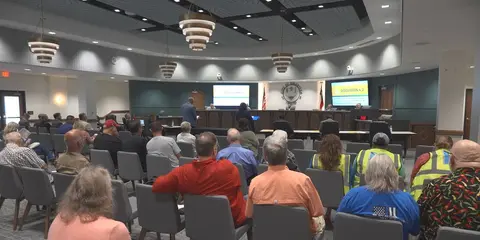
AMARILLO, Texas — The Amarillo City Council has spent months fielding questions about past financial records, and at its July meeting it turned to a harder question: what exactly a forensic audit is, what it would cover, and whether the city should commission one.
The discussion covered three areas — capital improvement projects, sewer and water, and money received under the American Rescue Plan Act — and reflected a council that has not yet agreed on whether anything is wrong.
Supporters framed it as a trust exercise. "We need our staff and we need our stakeholders and everybody in Amarillo to understand a forensic audit is just a formalized audit that digs down deep without some handcuffs and it goes in to areas where it needs to find clarity and it follows the money to the end," said Mayor Cole Stanley.
Others were unconvinced. "To me, it doesn't matter if it costs $1 or $200,000. If it's worth doing, it's worth doing. If it's not, it's not. And that's what I want to come to is my own conclusions of where we stand on this and the questions and do they really merit a forensic audit?" said council member Les Simpson.
Council directed staff to call a special meeting in August, and said the audit committee will vet and recommend a third-party firm for the full council before anything proceeds.
What a forensic audit actually is
The mayor's description captures the intent, but practitioners draw a sharper line, and the distinction determines what the city gets for its money.
A financial audit tests whether statements are presented fairly under accounting standards. Sampling is designed to support an opinion on the statements taken as a whole, which means a single improperly procured contract can be immaterial to the opinion and still be exactly what residents are asking about.
A performance or compliance audit tests whether specific rules were followed — procurement law, grant terms, fund restrictions. This is closer to what the council appears to want, and it is usually the cheaper instrument.
A forensic engagement exists to establish facts that can survive challenge: whether specific transactions occurred, who authorised them, what the money bought, and whether documentation was altered or created after the fact. It assumes the possibility of dispute, so work is documented to evidentiary standards rather than sampled for an opinion. That is what the phrase "follows the money to the end" means in practice, and it is why these engagements cost multiples of a standard audit per hour.
Why the existing audits would not have answered these questions
This is the point most often missed in these debates. Amarillo already produces audited financial statements, and by all accounts those audits were issued. Their existence neither confirms nor refutes the concerns being raised, because their scope was different.
On federal money there is an additional layer. Expenditures of federal awards above the applicable threshold trigger a single audit with testing of compliance for major programs — under the Uniform Guidance that threshold has stood at $750,000 — but the single audit asks whether award terms were met at the program level, not whether a specific capital project was the best use of the money or whether it was procured as required at every step.
Where ARPA funds are concerned, the practical exposure is not only accounting error but clawback: funds spent outside eligible uses, or outside the permitted period, can be subject to recovery. That is a specific, quantifiable risk and a defensible reason to test those records even if nothing else is examined.
Scope is the whole decision
Cost expectations like "$1 or $200,000" are really scope expectations in disguise. Forensic work is billed on hours against records, and hours scale with three things: the number of years examined, the number of funds and programs in scope, and how well the records are organised when the auditors arrive.
A request covering "capital improvement projects, sewer and water, and ARPA" with no stated period is not yet a scope — it is three scopes, each of which could be bounded or open-ended. The realistic sequence is:
- Fix the period first. Years examined drive cost more than anything else, and the answer usually follows from which decisions are in dispute.
- Fix the population second. "All capital projects above X dollars in the period" is defensible and testable; "all capital spending" invites drift.
- Decide the questions. Was procurement competitive, was change-order authority respected, were restricted funds used for eligible purposes, were transfers between funds properly authorised? Each question adds cost and each omitted one leaves a gap critics will point to.
- Phase the work. Start with the highest-value records; add phases only if phase one produces something.
- Require periodic reporting to the council in open session, with defined deliverables and a budget ceiling per phase.
Commissioning it properly
Three process constraints apply to a Texas city and shape how the engagement must be set up.
Professional services of this size are generally procured through a competitive process, so the request for proposals needs to be written from the agreed scope. A vague RFP produces vague proposals and contested pricing later.
Deliberation and voting must occur in properly posted open session, which is why an informally arranged version of this — a council member emailing a firm — creates problems regardless of intent.
And the work product will likely be disclosable. Public information law generally reaches records held by or for the governmental body once the engagement concludes, which narrows the space for confidential findings. If the council wants work that could support litigation or personnel action, that must be structured deliberately from the outset rather than retrofitted.
The governance question underneath
Parallel to the audit discussion, the council has been weighing changes to the Audit Committee itself. Coverage of the same July meeting described a committee that meets once a year, with proposals to move to quarterly or monthly meetings, a more active role in vetting forensic auditors, and direct tracking of major capital projects — oversight of a budget reported at roughly $570 million.
That is the durable fix. A forensic audit produces a point-in-time answer; a committee that meets monthly and reviews capital project status continuously produces the condition in which problems surface while they are still small. Cities that commission audits and leave oversight unchanged tend to be back at the same podium a few years later.
The counterargument deserves a fair hearing too. Simpson's position is not obstruction; it is asking what specific question the expenditure is meant to answer. If the answer is vague, the audit will be expensive and inconclusive, and its real function will have been political rather than financial — establishing that something was done without establishing whether anything was wrong.
Watch list
- The August special meeting: whether the council settles on defined questions or resumes the definitional debate.
- Whether the RFP that emerges names a period, a population and a dollar threshold.
- Whether the fee is structured per phase with a ceiling, rather than open-ended.
- Whether the audit committee's meeting frequency actually changes — the cheapest oversight reform on the table.
- Whether the audit finds nothing. A clean result is a legitimate outcome and a useful one, provided the scope was genuinely broad enough to support the conclusion.
Sources
- Coverage of the Amarillo City Council discussion: scope covering capital improvement projects, sewer and water and ARPA monies; months of questions from council members and residents about where funds came from and went; the quotations from Mayor Cole Stanley and council member Les Simpson; council direction to staff to call a special meeting in August; and the audit committee's role in vetting and recommending a third-party firm to the full council.
- Meeting records and coverage of the 14 July 2026 council session describing the proposed overhaul of the Audit Committee, its once-yearly meeting cadence, proposals for quarterly or monthly meetings, a role in vetting forensic auditors and tracking major capital projects, and a city budget figure of about $570 million.
- Note: the explanation of audit typologies, the Uniform Guidance single-audit threshold, the five-step scoping framework, the Texas procurement, open-meetings and public-information considerations and the watch list are the author's analysis, not statements by the City of Amarillo.