Bureau Veritas Marine & Offshore has granted Approval in Principle to Seatrium Technology & Innovation, the technology arm of Singapore offshore and marine group Seatrium, for a 30MW floating data centre concept known as SeaDC. The award, published on 27 July 2026, does not authorise construction. But it is the clearest evidence yet that the shipbuilding and offshore engineering sector is aiming itself at the least discussed bottleneck in the AI build-out: not chips, but land, grid connections and cooling water.
What an AiP does and does not mean
An Approval in Principle is a concept-stage endorsement. Bureau Veritas independently assessed whether the fundamental design is technically feasible, reviewing it against applicable BV Rules, international standards and relevant regulatory requirements. The scope covered the general arrangement, the cooling process flow, preliminary stability, marine systems and key safety considerations. That is deliberately broad and deliberately shallow: no detailed scantlings, no classification survey of a specific hull, no operational permit.
Its purpose is de-risking. By engaging at the concept stage, BV says it can help developers identify technical risks early and establish a clear pathway towards compliance. For a floating asset carrying no precedent, that pathway is the product being sold as much as the design itself.
The award also sits inside a wider relationship. It builds on a memorandum of understanding signed by Bureau Veritas and Seatrium during Singapore Maritime Week earlier in 2026 to advance offshore power and digital technologies, so further joint work should be expected.
The design: barge, not boat
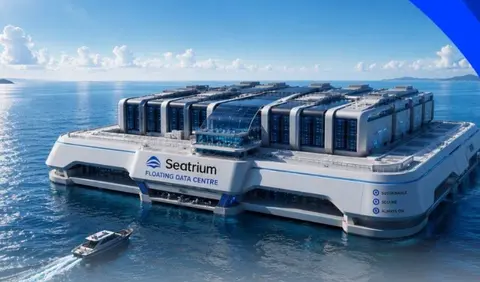
The concept is a jetty-moored, non-propelled barge carrying six independent 5MW 'Data-in-a-Box' modules. Each module integrates IT equipment, cooling systems, power distribution and supporting infrastructure in one compact unit.
Two engineering choices carry most of the argument.
The first is water. The facility would use natural seawater cooling rather than evaporative towers, removing the draw on potable water that has made data centres unpopular neighbours in water-stressed cities. In jurisdictions where water allocation is becoming a planning constraint, that single feature can shorten the political timeline more effectively than any technical improvement.
The second is modularity. Six discrete 5MW units convert one monolithic project into six repeatable ones. Capacity can be added in phases as contracted rather than built once and sold into; construction can proceed while earlier modules are already earning; maintenance can be carried out on one unit without taking the whole facility offline. It mirrors the module logic used in floating production units, and it is precisely what gives a yard confidence in schedule and cost.
Mooring to a quay rather than installing propulsion also simplifies things: no dynamic positioning, no crew for transit, no redundancy for manoeuvring. The flip side is dependence on a specific berth and its grid connection — which is where the siting argument gets harder.
Why the demand exists
Seatrium frames the concept as a response to land, grid and cooling constraints in coastal markets facing rising AI, cloud and edge computing loads. Singapore, the company's home market, is the archetypal case.
New data centre construction there was effectively frozen by a moratorium starting in 2019. It was relaxed through a pilot Data Centre – Call for Application exercise in July 2022, with four proposals selected in 2023 sharing 80MW: an AirTrunk–ByteDance consortium, Equinix, GDS and Microsoft. The second call, DC-CFA2, was announced by the Economic Development Board and IMDA on 1 December 2025, offering at least 200MW — with the option of further allocations for projects pursuing innovative green energy pathways — and requiring best-in-class IT and energy efficiency plus at least 50% of power from green sources such as biomethane, low-carbon ammonia, hydrogen, novel fuel cells with carbon capture, or on-site solar. Applications closed on 31 March 2026.
The quantity being allocated tells the story. Two hundred megawatts is modest against the pace of AI demand; operators in the region routinely discuss individual AI campuses measured in hundreds of megawatts. Singapore's Green Data Centre Roadmap targets power usage effectiveness below 1.3 for new builds, so applications are won on thermal design as much as on price. Add land scarcity — Turner & Townsend ranked Singapore second globally in its 2025 data centre construction cost index at US$14.53 per watt, behind only Tokyo — and the search for solutions outside the land boundary becomes rational rather than exotic. Local media have also reported occupancy above 95% alongside grid constraints, though that figure should be treated as secondary.
For that market, a floating facility offers a plausible route to capacity that does not consume industrial land and does not need potable water. Whether it can access power is another question; floating does not create electrons.
What remains unresolved
Several things have to be true before SeaDC becomes an order.
Classification status. A non-propelled barge hosting server halls is an awkward fit for existing categories, sitting somewhere between a port facility, a floating installation and a vessel. Flag state and port state positions will shape everything downstream.
Grid and shore power. Thirty megawatts drawn through a quayside connection is transmission-scale infrastructure. In most congested markets, the queue for that connection is the constraint the barge was supposed to escape.
Thermal discharge. Taking heat into a harbour is not free. Warm water return, biofouling and local marine impact require permits, and permitting is where projects like this typically stall.
Uptime credibility. Hyperscale tenants underwrite very high availability. Salt-laden air, humidity and low-frequency motion all attack electronics and mechanical plant, and cooling loops exposed to untreated seawater raise fouling and corrosion questions that a concept review cannot settle.
Insurance, financing and exit. Lenders finance assets against precedent and resale value. A first-of-kind asset with a long economic life and no resale comparables prices poorly.
None of this is a flaw in the concept. It is the normal distance between an Approval in Principle and a delivered asset, and Seatrium's own framing concedes it: independent technical assurance will be important as projects move from concept to implementation.
The 100MW question
Seatrium is developing a 100MW version based on the same reference design, presenting it as a clear pathway to hyperscale deployment while retaining modular construction, seawater cooling and flexible offshore siting. Scaling by a factor of more than three is more than addition: mooring loads, fire and safety zoning, distribution voltage and single-fault resilience all change non-linearly with density. The 30MW unit reads as a credible reference precisely because it stays small enough to be boring.
Who else is in the water
Seatrium is not alone. Keppel publishes a floating data centre among its own innovation portfolio, positioning it as Singapore's first such facility, though its current status is not independently confirmed here. A broader ecosystem is emerging around prefabricated cooling and marine-sited digital infrastructure, including water-efficient liquid cooling specialists addressing the same constraints. Several designs competing inside one regulatory window tends to accelerate the framework everyone needs.
The commercial read
For offshore yards, this is diversification. Heavy steel assembly, module integration and power systems translate from LNG carriers and floating production units into digital infrastructure, and the customer base shifts from energy majors towards hyperscalers and colocation operators. For those customers, floating capacity is a hedge against land and power queues — attractive mainly where those queues are the binding constraint.
Three signals are worth watching: a front-end engineering design award or letter of intent from a named operator; published power usage effectiveness and water usage figures rather than claims; and a credible date for first power. Until one of those appears, SeaDC is a well-engineered answer to a real question, awaiting a customer.
Sources
- Bureau Veritas Marine & Offshore newsroom, 'Bureau Veritas grants Approval in Principle to Seatrium's 30 MW Floating Data Center concept', 27 July 2026 (primary: scope of BV's feasibility assessment, six 5MW Data-in-a-Box modules, link to the BV–Seatrium MoU signed at Singapore Maritime Week, quotes from Drago Pinteric and Aziz Merchant).
- Riviera Maritime Media, 30 July 2026: SeaDC naming and jetty-moored configuration detail.
- Morgan Lewis LawFlash, 3 March 2026, citing IMDA and EDB: DC-CFA2 terms, the 2022 pilot call and its 80MW outcome, the Green Data Centre Roadmap PUE target below 1.3, and Turner & Townsend's 2025 construction cost index (US$14.53 per watt, second behind Tokyo).
- Keppel Data Centres, Innovations: Floating Data Centre — concept status only, not independently verified.
- Singapore Business Review, May 2026 — secondary source for occupancy above 95% alongside grid constraints.