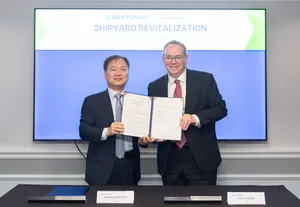
HD Korea Shipbuilding & Offshore Engineering, the intermediate holding company for HD Hyundai's shipbuilding businesses, has signed a memorandum of understanding with Fraser Industries LLC covering shipyard modernisation projects aimed at revitalising the US shipbuilding industry. The agreement was announced from Seoul on 29 July 2026 following a signing ceremony in Washington, DC, attended by HD Korea Shipbuilding & Offshore Engineering president and chief executive Kim Hyung-kwan, technology advisor Shin Jong-gye, and Fraser Industries chief executive Patrick V. Kelly.
The headline reads like a partnership to build ships. It is not. What is being offered is the capability to build — and run — a shipyard, packaged as a transferable product.
What the agreement actually covers
The scope runs across the full lifecycle of a yard, from construction through to operations:
- Shipyard assessments and solution development
- Yard and factory layout design
- Deployment of robotics and automation systems
- Optimisation of cost, schedule, quality and productivity
- Implementation of AI- and data-driven digital solutions
- Supply chain expansion and workforce training
To deliver it, HD Korea Shipbuilding & Offshore Engineering says it will package three things — shipyard design and construction know-how, production and operating systems, and data management capability — into a single integrated offering described as smart shipyard technology. In effect, it is selling its accumulated knowledge of how to run a yard, not steel.
The next step is a consulting contract. The two companies plan to sign a shipyard modernisation consulting agreement within the year, using Fraser Shipyards on the shore of Lake Superior as a demonstration model.
Why this is strategically different from an ordinary MOU
In March, HD Korea Shipbuilding & Offshore Engineering added 'development and supply of digital engineering and manufacturing platforms' to its business objectives and designated comprehensive shipyard construction solutions as a future growth driver. This is the first concrete project since that change.
That shift matters. Korean shipbuilding has spent a decade climbing back to profitability on the back of high-value gas carriers, where order selection and production discipline, rather than volume, have driven returns. Selling that discipline as consulting and software is an asset-light third revenue line: it does not consume dock capacity, it is priced on expertise rather than tonnage, and it is defensible in a way that hull construction increasingly is not.
It also arrives into a receptive policy environment. The Great Lakes region has emerged as a focal point for US efforts to rebuild shipbuilding capacity, and industry participants there are aligning with the US government's Maritime Prosperity Zones initiative. Fraser Shipyards, Fincantieri Marine Group and Donjon Marine have formed the Great Lakes Shipyard Alliance and are jointly pursuing work including the US Coast Guard's new light icebreaker programme. The region has long hosted shipbuilding, maintenance and repair activity and retains a maritime supply chain that most of the US coast has lost.
The demonstration model logic
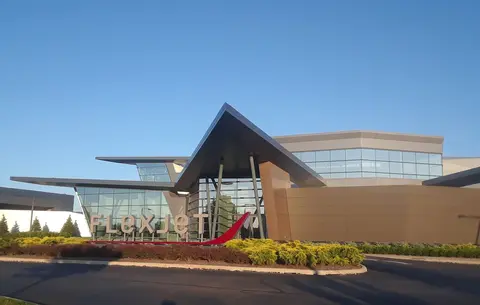
Choosing Fraser as the reference site is deliberate. Fraser Shipyards, located on Lake Superior in Superior, Wisconsin, has been preparing to expand production. It is large enough to be credible, old enough that productivity gains will be visible, and American enough to be cited in Washington.
A modernisation programme that measurably improves throughput at Fraser becomes a before-and-after case study that can be sold to every other yard facing the same problem. Conversely, if the demonstration is slow or the gains prove hard to evidence, the whole platform loses momentum. Everything therefore depends on the consulting phase producing numbers rather than slideware.
The parts that are genuinely hard
Scepticism about US shipbuilding revival schemes is not cynicism; the constraints are structural.
Labour. US yards face shortages of welders, pipefitters and marine engineers that cannot be closed by software. Training pipelines take years, and automation only helps where the work is repetitive enough to automate.
Product mix. Korean productivity comes partly from series production — repeat units, stable designs, long runs. Much of the US Jones Act market is low-volume and highly customised, exactly the context in which Korean-style production engineering delivers least.
Supply chain. Equipment lead times and a thin domestic supplier base mean that yard-side efficiency may simply move the bottleneck upstream.
Technology transfer. Data rights and platform ownership are unresolved in almost every such arrangement. Whether the AI and digital tooling is licensed, embedded with data flowing back to Korea, or eventually owned outright will determine how much strategic value actually transfers.
Capacity at home. Korean yards are busy. Diverting senior production engineers to advisory work has an opportunity cost, and promoters of these programmes rarely price it.
Policy continuity. Programmes tied to federal initiatives carry election-cycle risk, and infrastructure grants or procurement preferences can change faster than a yard modernisation can be amortised.
What would constitute real traction
Three markers are worth watching. First, the consulting contract itself: is it signed within the year as planned, and is it big enough to matter? Second, whether a second US yard signs on — one customer is a pilot, three is a business. Third, whether follow-on commercial work is committed — equipment orders for the yard, module supply, or block fabrication sourced from Korean facilities.
Icebreaker work is a useful proxy for whether the regional strategy is working at all. If the Great Lakes Shipyard Alliance wins meaningful Coast Guard tonnage, the supplier base has a reason to invest; if not, the campus remains a demonstration and not much else.
The commercial read
For HD Hyundai, economics come first: this is a way to monetise engineering expertise on someone else's balance sheet, with a US policy tailwind and without building new docks. For Fraser, it is access to production methods it cannot develop internally at the same speed. For Washington, it is a testable route to capacity that does not rely solely on subsidies.
The MOU costs nothing and commits little. Its value will be judged by whether the demonstration produces measurable improvement at Fraser and whether that improvement converts into contracts elsewhere. Until then, it is best read as the opening move in a strategy — selling the factory rather than the ship — that Korean yards have been circling for years.
Sources
- HD Hyundai via PR Newswire, 'HD Hyundai to Help Modernize U.S. Shipyards with End-to-End Shipyard Solutions', 29 July 2026 (primary: MOU scope, names and titles of attendees, integrated smart shipyard package, plan to sign a consulting contract within the year, Great Lakes Shipyard Alliance and the US Coast Guard light icebreaker programme, both quotes).
- WorkBoat, 'Fraser, HD Hyundai sign shipyard modernization agreement', 27–30 July 2026: Fraser Shipyards' expansion plans at Superior, Wisconsin.
- Smart Maritime Network and World Ports coverage, late July 2026, for corroboration of the MOU and its framing as HD Korea Shipbuilding & Offshore Engineering's first comprehensive shipyard-solutions project.