
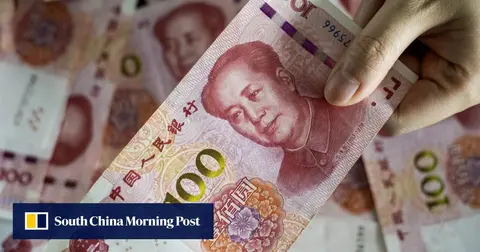
China's offshore yuan rose to a fresh three-year high on Friday after the central bank set the daily fixing stronger than 6.79 per US dollar for a third consecutive session, and a high-level party meeting signalled further policy support.
The combination matters. A currency does not reach a three-year high on political language alone — but in China's managed regime, no move of this size happens without a signal that it will be tolerated.
What actually happened
On Friday, the People's Bank of China set the yuan's midpoint — the daily fixing rate — at 6.7894 per US dollar, a third straight session above 6.79. The level was marginally weaker than Thursday's 6.7892, which was itself the strongest since February 2023.
The offshore yuan, which trades more freely than its onshore counterpart, went further. It extended its rally to 6.7433 (per dollar) by early Friday afternoon, its strongest since February 2023, having reached 6.7439 on Thursday, according to Chinese financial data provider Wind.
Alongside the moves, the Communist Party's Politburo met the same day and pledged to step up macroeconomic policy support and enhance the resilience of capital markets for the remainder of the year — signalling intent to stabilise growth amid a recent slowdown in activity and elevated volatility in global markets.
Why the fixing is doing the work
The daily midpoint is the most informative price in China's currency regime. The PBOC publishes it each morning; the onshore rate trades within a band around it, while the offshore rate trades freely. A stronger-than-expected fixing therefore communicates tolerance — sometimes outright preference — for appreciation, well before any intervention is observable.
Three consecutive sessions above 6.79 is a pattern rather than an accident. Read correctly, it tells markets that the authorities were not unsettled by the currency's rise, which removes the primary risk premium normally attached to buying CNH: the possibility that official preference reverses overnight.
The policy signal behind it
"We are bullish [on] the Chinese yuan as a hedge against war, but potential stimulus is a reason to stay bullish even in peacetime," Abbas Keshvani, Asia macro strategist at RBC Capital Markets, said on Thursday, pointing to the Politburo's pledge to accelerate fiscal spending amid slowing growth.
In a note earlier in the month, the strategist observed that the yuan had outperformed traditional defensive currencies — the Singapore dollar, Japanese yen and Swiss franc — since the outbreak of the US–Israel war on Iran, adding that Chinese authorities tend to "marshal the currency through periods of volatility".
That formulation captures something investors frequently misprice. Stability in the yuan is not incidental; it is produced. Where other currencies function as risk gauges, the yuan has increasingly functioned as an anchor — a deliberate output of policy rather than a reflection of capital flows.
The economics beneath the politics
A firmer currency carries real costs, and Beijing is unlikely to pursue appreciation for its own sake.
Exporters absorb margin compression as conversion into yuan yields fewer units, a sensitivity amplified in low-margin assembly and textiles. Importers, by contrast, benefit: energy, commodities and semiconductor inputs become cheaper in local terms, which quietly functions as disinflation at a moment when domestic demand needs support. For households and firms borrowing in dollars, a stronger yuan eases servicing costs.
Portfolio behaviour is the swing factor. A currency that appreciates steadily and does not gap lower reduces the hedging cost of holding local assets, making onshore equities and bonds more attractive at the margin. That is likely part of the intent behind the Politburo's commitment to capital market resilience.
How fragile is the move
Three tests will determine whether strength persists.
Delivery on stimulus. Words moved the currency; only deployed fiscal spending keeps it at these levels. If additional support fails to appear in coming months, the growth argument weakens and tolerance for depreciation is likely to return quite quickly.
The dollar. A large share of the yuan's strength is the counterpart of dollar weakness. Should US data or policy shift that backdrop, the fixing will reflect it — and the PBOC has historically allowed more give than markets anticipate when the external environment turns.
Tolerance itself. Authorities have shown they are comfortable with gradual, orderly appreciation, which is not the same as tolerating a disorderly squeeze. Positioning that leaves markets leaning one way through a policy change is how abrupt reversals occur.
The read
Analysts are justified in describing themselves as bullish on the yuan, with the caveat that the thesis rests on policy rather than valuation — a support that can be withdrawn faster than it is granted.
For corporate treasurers, the practical implication is to review hedge ratios while the currency is strong, since that is when protection is cheapest and least discussed. For investors, the more durable takeaway is structural: over recent years of volatile global markets, China has treated currency stability as a policy instrument, and the level has been managed rather than merely discovered.
Sources
- People's Bank of China daily fixing: 6.7894 on Friday, 6.7892 on Thursday — third consecutive session above 6.79 per dollar and the strongest since February 2023.
- Wind Information, cited for offshore yuan levels: 6.7433 early Friday afternoon, following 6.7439 on Thursday — strongest since February 2023.
- Politburo meeting statement, same day: pledge to step up macroeconomic policy support and enhance the resilience of capital markets.
- Abbas Keshvani, Asia macro strategist, RBC Capital Markets — quoted remarks on staying bullish on the yuan, potential stimulus, relative performance against the Singapore dollar, yen and Swiss franc, and authorities' tendency to "marshal the currency through periods of volatility".
- Note: interpretation of the fixing mechanism, exporter and importer effects, and durability tests above is the author's analysis.