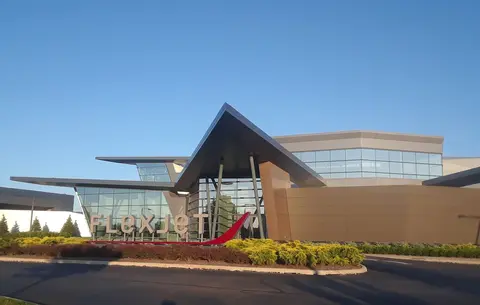
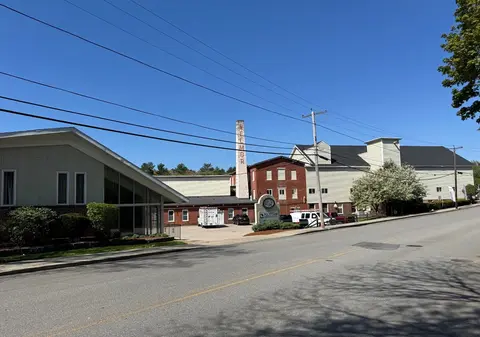
Westerly, Rhode Island — The Washington Trust Company has provided $13.6 million in financing to McGovern MHQ Inc., supporting the New England vehicle upfitter's acquisition of production facilities in Marlborough and Uxbridge, Massachusetts — including a largely vacant 19th-century textile mill that will return to active industrial use. The bank announced the deal on 30 July 2026.
Roughly $13.6 million is small by most standards. What makes it worth attention is what it finances: an owner-occupier moving from tenant to owner of its own production capacity, using a historic industrial property that conventional industrial development would have written off.
The assets
Two packages were financed.
The larger is an 18.85-acre campus at 44 Rivulet Street in Uxbridge, containing 131,000 square feet of space within the historic Rivulet Mill complex. The site, developed for textile production in the early 1800s and later operated by manufacturers tied to Rhode Island's Blackstone Valley textile industry, is listed on the National Register of Historic Places. It will roughly double the production space available to McGovern MHQ's truck equipment operations, which currently run from a leased facility in Oxford, Massachusetts.
The second covers an approximately 80,000-square-foot facility on a 12-acre campus spanning 401 Elm Street, 415 Elm Street and Smith Drive in Marlborough — already a hub for high-volume upfitting, service and fleet support. Acquiring it converts the company from occupier to owner of a critical operating asset.
Why owning rather than leasing matters here
For a manufacturer, ownership is less about real estate appreciation than control. Tenants face renewal risk on specialised facilities whose improvements cannot easily be moved; upfitting bays, hoists, electrical work and layout are sunk into someone else's building. Ownership removes the landlord from long-term planning and makes fit-out investment bankable.
The trade-off is capital. Buying two facilities locks balance sheet into illiquid property when that cash could fund inventory, acquisitions or working capital. The calculation only works when occupier demand for the specific asset is durable — and it is here, because this is not speculative space. These are operating facilities with existing throughput.
The mill: heritage as a constraint and an asset
Adaptive reuse of older New England mill buildings is not a nostalgia project; it is an arithmetic problem. Mill construction often delivers high ceilings, heavy floor loads and wide column spacing that suit manufacturing better than they suit offices, and the buildings sit near established labour markets and transport routes.
Against that: environmental remediation, ageing fabric, code compliance, insurance and energy performance obligations. Historic listing can restrict alterations while also opening doors to rehabilitation incentive programmes at state and federal level. Because eligibility and rates vary by jurisdiction and by whether assets are income-producing, any credit support from those programmes must be underwritten explicitly rather than assumed — particularly in rehabilitation budgets, where overruns are the rule rather than the exception.
That a largely vacant complex is returning to industrial use carries genuine regional weight in the Blackstone Valley, where textile manufacturing once linked communities across Rhode Island and Massachusetts.
The borrower
Founded in 1979 and acquired by Matt McGovern in 2023, McGovern MHQ is one of the largest municipal vehicle upfitters in New England, providing customised solutions for police, fire, emergency medical services and public works fleets.
Public safety fleets are a distinctive end market. Procurement is driven by municipal and state budgets rather than consumer credit; replacement cycles are governed by duty cycles and grant funding; and specification requirements are tightening as vehicles accumulate electronics, lighting, communications and power systems. Upfitting has become an engineering discipline, not a bolt-on trade. Revenue visibility is consequently better than in much of commercial vehicle services — although it depends on municipal fiscal health, which is cyclical in a different rhythm from the economy.
Why a community bank won this deal
Washington Trust was founded in 1800 and describes itself as the oldest community bank in the nation, the largest state-chartered bank headquartered in Rhode Island, and a subsidiary of NASDAQ-listed Washington Trust Bancorp, Inc. It marked 225 years of operation in 2025.
Regional lenders win this type of mandate on judgement rather than price. A loan secured partly by a historic mill with a single-tenant use requires someone to understand the borrower's franchise and the building's reuse economics — which is easier to do from Westerly than from a syndicated desk. Private credit would likely have priced the same exposure wider.
The trade is also strategic for the bank. Joseph Confessore, senior vice president and managing director of commercial and private banking, tied the financing to expanding footprint and capacity, moving operations into owned facilities, 'while also bringing renewed economic activity to a historic mill property and returning it to active industrial use'. That combination — relationship lending with visible local impact — is precisely the franchise a community bank must defend against non-bank competitors.
What to watch
Three variables determine the outcome. Conversion cost: bringing a vacant mill complex into productive use rarely lands on budget. Demand durability: municipal fleet budgets are stable until they are not, and a single large contract loss would test the fixed-cost base that ownership creates. And execution risk in moving operations out of the Oxford leased site without interruption — upfitting businesses sell reliability of delivery as much as the vehicle.
Judged narrowly, this is a $13.6 million commercial real estate loan. Judged properly, it is a small case study in how regional capital still finances industrial expansion that national markets tend to overlook.
Sources
- The Washington Trust Company, 'Washington Trust supports regional business growth with $13.6 million financing deal', 30 July 2026 (primary: financing amount, both properties, square footage and acreage, Rivulet Mill's National Register listing, corporate history of McGovern MHQ, and the quote from Joseph Confessore).
- Providence Business News, 3 August 2026; Worcester Business Journal and Worcester Telegram, late July and early August 2026 — secondary coverage of the purchase and its local impact.
- Note: analysis of adaptive reuse economics, municipal fleet demand and the owner-versus-tenant trade-off is the author's, based on the facts above.