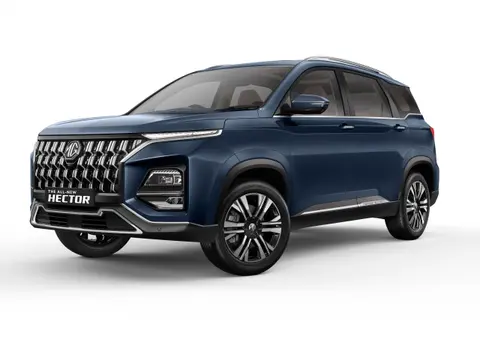
JSW MG Motor India has launched an anniversary programme for the MG Hector, marking seven years of the SUV in the Indian market. Customers booking an eligible Hector during August 2026 can receive benefits worth up to Rs 60,000, combining exchange bonuses, loyalty rewards, corporate benefits and anniversary discounts. The All-New MG Hector range starts at Rs 11.99 lakh (ex-showroom).
A seasonal campaign is not news in itself. What makes this one worth reading is what it reveals about how a mid-cycle model is now defended: less through the price line, more through the financing attached to it.
What is on offer
Two elements, running together.
The first is the benefit stack — up to Rs 60,000 in headline value, assembled from four sources. Only some apply to any given buyer. An existing MG owner will typically trigger loyalty benefits, a first-time buyer will not; a customer trading in a vehicle accesses exchange benefits; corporate buyers draw on a separate entitlement. The maximum figure describes the best case rather than the typical transaction.
The second is financing support, and it is the more substantive component. JSW MG Motor India is offering funding of 100 per cent of on-road price on tenures of up to 84 months, plus full funding support on accessories. A zero-money-down structure over seven years changes the affordability calculation more than any discount.
Vinay Raina, chief commercial officer, JSW MG Motor India, framed it as an ownership programme: "As we celebrate this important milestone, we wanted to thank our customers with an ownership programme that delivers value far beyond the purchase of the vehicle."
The arithmetic behind the finance offer
Full on-road funding removes the down payment barrier at the point of purchase, which is where many transactions are lost — not on monthly affordability but on the lump sum required at signing. On a vehicle priced near Rs 12 lakh ex-showroom, on-road cost after insurance, registration and taxes lands materially above that; financing all of it shifts the entire transaction onto instalments.
Extending to 84 months lowers monthly outgo further. The trade-off is duration risk. Seven-year loans on depreciating assets create negative-equity exposure for most of the term, meaning customers who need to exit early — through job change, relocation or default — may owe more than the vehicle is worth. Longer tenures also raise total interest paid substantially.
For the manufacturer, this is a well-understood lever: it defends monthly affordability without altering the sticker price, which protects residual values and the model's positioning. Subsidised funding is booked as a marketing cost rather than a discount, and its effects disappear quickly once support is withdrawn.
Why the Hector needs it
Launched in 2019, the Hector has been updated with an All-New Hector earlier this year, and the SUV segment around it has intensified considerably. Rivals across petrol, diesel, hybrid and electric drivetrains now compete for the same buyer, and models near this price band are particularly contested.
In that environment an anniversary serves two purposes. It gives the brand a reason to communicate without appearing to cut price — always a damaging move for resale value — and it provides a genuine reason for fence-sitting buyers to commit in a specific month, converting latent demand into August volumes.
The product refresh provides supporting evidence. The All-New Hector features the Aura Hex Grille, redesigned Aura Sculpt bumpers and Aura Bolt alloy wheels, offered in Celadon Blue and Pearl White. Seven-seat variants adopt a Dual-Tone Urban Tan interior theme, the five-seat version a Dual-Tone Ice Grey theme. Equipment includes a 14-inch HD portrait touchscreen with Smart Boost technology, i-SWIPE touch gesture controls, a digital Bluetooth key with key-sharing functionality, predictive maintenance alerts and remote AC control, alongside a 17.78cm digital instrument cluster and more than 70 connected-car features.
Reading the offer
Connected features deserve particular attention. A large installed base generating recurring telematics and subscription revenue makes warranty extensions, service packages and usage-based insurance commercially viable, and these are higher-margin, less cyclical than vehicle sales. It also raises replacement economics: customers embedded in a connected ecosystem are likelier to stay within it at their next purchase.
That is the logic behind "value far beyond the purchase of the vehicle". These programmes serve both marketing and balance sheet objectives.
What buyers should check
Three questions cut through the presentation. Which of the four benefit categories actually apply — the realistic figure is usually well below Rs 60,000. What total cost results from an 84-month structure: compare total interest across tenures, since extending from five years to seven substantially increases the amount repaid even when the monthly payment looks comfortable. And what the offer does to exit options, because zero down payment maximises exposure if circumstances change while negative equity persists.
Used wisely, this is genuine value. The caution is simply that the money spent to make a vehicle seem affordable is still money spent — it moves from the down payment into monthly instalments, where it becomes easy not to notice.
Sources
- JSW MG Motor India announcement of the MG Hector anniversary programme, August 2026: benefits of up to Rs 60,000; component benefits; financing terms of up to 100 per cent on-road funding for tenures of up to 84 months and full accessories funding; starting ex-showroom price of Rs 11.99 lakh; product specification and feature list; quote from Vinay Raina, chief commercial officer.
- Autocar Professional and other trade coverage, 10–11 August 2026, for corroboration of the programme's structure and timing.
- Note: commentary on loan tenure economics, negative equity, stickiness of connected-car ecosystems and buyer due diligence is the author's analysis, not the manufacturer's.