
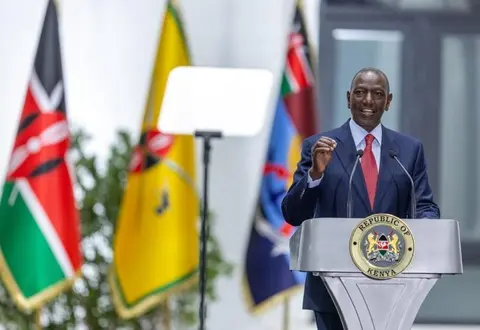
President William Ruto's plan to provide 100 per cent government funding for students joining universities and colleges from September 2026 could remove the upfront cost of higher education, but graduates may later repay the money through deductions from their salaries.
A proposed Tertiary Education, Placement and Funding Bill, 2026 would allow the new Tertiary Education Funding Authority (TEFA) to recover education loans from graduates in employment, with monthly deductions capped at 25 per cent of their earnings.
The provision is contained in Clause 49(4) of the Bill.
"In making deductions for loan repayment, the Authority shall deduct not more than twenty five percent of the loanee's emoluments," the Bill states.
The wording is important: 25 per cent is the maximum, not an automatic deduction for every graduate.
The proposed system would replace the current Higher Education Loans Board (HELB) framework with TEFA, which would oversee higher education funding and loan recovery.
The changes could affect thousands of students expected to join higher education under Ruto's new funding model.
Full funding, future repaymentRuto announced in July that students admitted to universities and colleges from September 2026 would receive full government funding for their higher education.
The President said the government would cover the cost of higher education, with parents able to contribute if they wished.
But the proposed Bill gives the funding a crucial financial dimension.
Under the new framework, government support would be provided through education loans that beneficiaries would eventually repay. Reporting on the Bill indicates that the proposed model would move away from the current mix of scholarships, loans and household contributions towards a more universal loan-based system.
This means the immediate question for families may no longer be simply how to raise university fees, but how much of a graduate's future income will go towards paying for that education.
The Bill provides that a loanee would begin repaying the education loan within one year of completing their studies, together with accrued interest and other applicable charges.
For students entering university in September, the financial impact could therefore extend well beyond graduation.
How 25% deduction worksThe proposed salary deduction would apply when a graduate enters employment.
A loanee in formal employment would be required to disclose their loan status to the employer. The employer would then notify TEFA and deduct the monthly repayment amount determined by the Authority.
The Bill states that deductions would continue until the loan is fully paid or the borrower leaves that employment.
Employers would also be required to remit the money to TEFA within nine days after the end of each month.
Failure to remit deductions on time could attract a penalty equal to 5 per cent of the repayment amount for every month, or part of a month, that the money remains unpaid.
For graduates, however, the 25 per cent ceiling is the most significant provision.
Consider the possible maximums: a graduate earning Ksh40,000 a month could have up to Ksh10,000 deducted, while someone earning Ksh60,000 could have a maximum of Ksh15,000 deducted. For a graduate earning Ksh100,000, the maximum deduction would be Ksh25,000.
These are illustrative calculations based on the proposed 25 per cent ceiling. They do not mean TEFA would automatically deduct those amounts from every graduate.
The actual repayment would depend on the amount determined under the final law and regulations.
What it means for graduatesThe proposed system could fundamentally change how Kenyans experience the cost of university education.
Under Ruto's plan, a student could potentially begin university without their family having to raise the full cost of tuition and accommodation upfront.
But once that student graduates and enters formal employment, part of their income could be redirected towards repaying the education loan.
The model therefore shifts a significant part of the financial burden from the student's time at university to the student's working life.
That could provide immediate relief to families struggling with university fees while creating a new long-term financial obligation for graduates.
The issue is particularly significant for young Kenyans entering a competitive job market, where many graduates may already have other financial responsibilities when they secure their first jobs.
The proposed law would also make employers part of the loan recovery system, creating a formal link between employment and student-loan repayment.
TEFA to replace HELBThe Bill proposes creating TEFA to manage the financing of tertiary education and consolidate functions currently handled by different institutions.
The proposed changes are part of a wider overhaul of Kenya's higher education financing system.
However, the implementation of Ruto's September funding plan has faced uncertainty, with reports indicating questions remain over the legislative and administrative framework required to roll out the new model.
That makes the final version of the Bill particularly important for students and parents.
Parliament could amend the proposals before they become law, meaning the 25 per cent ceiling and other repayment provisions should be understood as proposed rules rather than final requirements.
For students preparing to join university in September, the headline promise is straightforward: the government says it will fully fund their higher education.
The repayment question is more complicated. If Parliament approves the proposed framework, that government-funded education could become a loan recovered from future earnings, with TEFA allowed to deduct up to 25 per cent of a graduate's salary.
For millions of Kenyan families, that could make the real cost of Ruto's university funding model a question not of what students pay today, but what graduates may repay tomorrow.